Best beaches in Cornwall
Cornwall's 300-mile coastline offers some of Britain's most spectacular beaches, from the wild surf breaks of the north coast to the sheltered turquoise coves of the south. Whether you're seeking world-class waves, family-friendly swimming, or hidden gems accessible only by coastal path, Cornwall's diverse beaches provide something for every traveler, with a mild Gulf Stream climate that extends the season well beyond typical British destinations.

One of Cornwall's only clothing-optional beaches, set in a dramatic cove beneath the granite cliffs of Logan Rock.

Reached by a seasonal rowing-boat ferry across the Gannel estuary — the only beach on this list you arrive at by boat.

The beach where world leaders gathered for the 2021 G7 summit, small enough to have its own railway halt right above the sand.

Dark serpentine sea stacks and caves, including a blowhole called the Devil's Bellows, at their most dramatic when the tide drops.

A secluded, untouched crescent of sand between two dramatic headlands, reachable only on foot down a National Trust path.

Cornwall's main beginner-surf beach, with several surf schools working the water and the Rumps hillfort walk at one end.

A surf beach backed by a small valley village rather than a seafront, with the Blue Bar sitting right on the sand.

Cornwall's longest unbroken stretch of sand, backed by low dunes that open up a wide view across Mount's Bay.

Sits right beside Looe's working fishing harbour, so you can watch the day's catch come in a few steps from the sand.

Tucked into the dunes: a freshwater spring hidden inside a sea cave that only reveals itself for a couple of hours either side of low tide.

A small, sheltered cove backed by tree-topped cliffs, with water clear enough to feel almost Mediterranean on a good day.

Newquay's main surf beach, and home to the Cribbar — one of England's only genuine big-wave breaks.

Bude's main beach, with a genuine 1930s tidal sea pool cut into the rocks at one end, open 365 days a year.

Secret low-tide cove offering complete seclusion beneath St Ives cliffs

A café terrace looks straight down over the sand here — the easiest of Falmouth's beaches to reach on foot from the town.

The most westerly beach on mainland Britain, with a working fishing cove and a lifeboat station dating back to 1853.

A clifftop walk from Land's End leads to a natural arch called the Song of the Sea, visible only at low tide.

St Ives' only beach that faces open Atlantic swell, with Tate St Ives standing right above it.

The smallest and most sheltered of St Ives' beaches, tucked into a sun-trap cove near the Island.

A working fishing harbour where the sand reappears — and the boats settle onto it — every low tide.

The St Ives branch line runs right along the top of this beach — you can watch trains pass from the sand.

Home to Britain's first surf life saving club, founded here in 1953 and still training from the beach today.
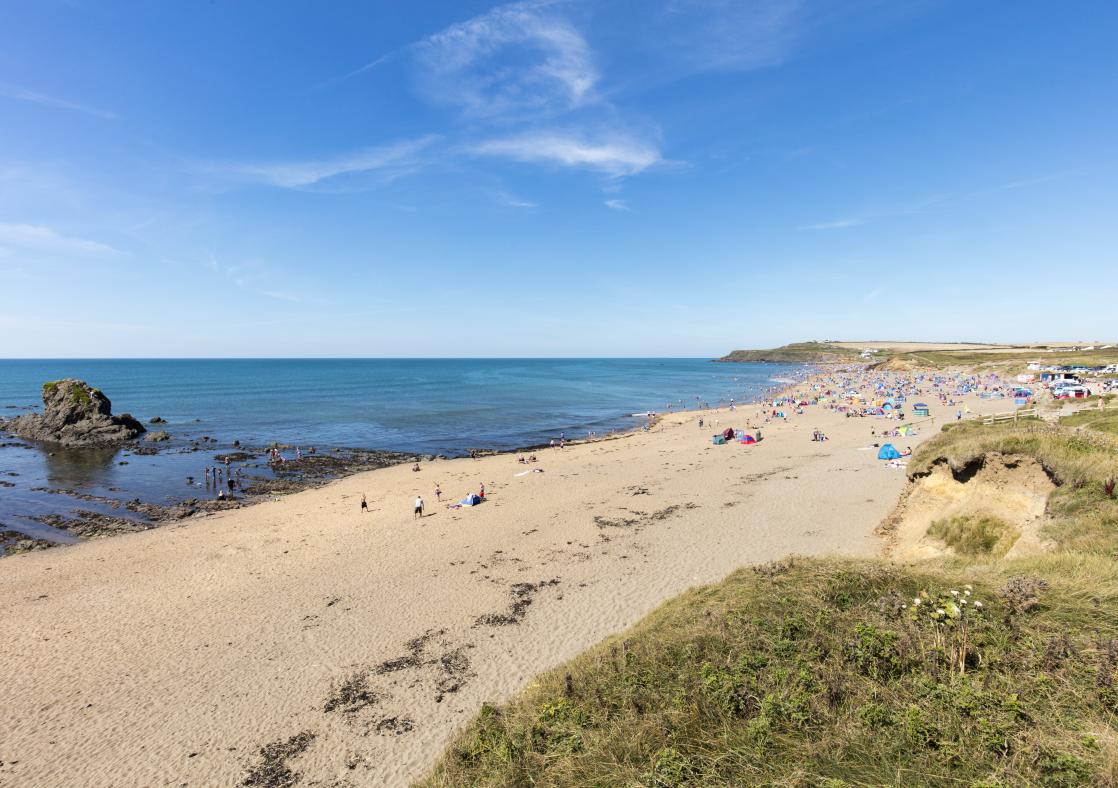
A big, open surf beach south of Bude, with the coast path running on past striking zig-zag rock formations at Millook.

Newquay's central beach, home to Jago's Island — a private house perched on its own rock, reachable only by footbridge.

Named after the old Great Western Railway service that first brought holidaymakers to Newquay, and still the easiest beach to reach by train today.

At high tide, the waves here wedge off the cliff into one of the UK's best bodyboarding waves — bigger swell than its Newquay neighbours.

Two miles of open sand run by the Extreme Academy — surfing, kitesurfing and land-yachting lessons straight off the beach.

A tidal stretch of sand near Padstow that grows to half a mile at low tide, reached along the coast path past St Saviour's Point.

An Iron Age burial ground was excavated on this gentle, sandy horseshoe bay — one of the more significant finds on this coast.

A short coast-path walk from here brings you to the Round Hole, a collapsed sea cave turned near-perfect circular blowhole.

Two miles of open sand backed by big dunes, with some of the best beach-break surf on this stretch of coast.

Unusually pale sand inside a granite amphitheatre, with the Minack Theatre carved into the clifftop directly above it.

At low tide, this beach joins with Carne next door across Gerrans Bay to form more than a mile of continuous sand.

National Trust cliffs here fold and twist into dramatic, contorted rock strata — a rare stretch of geology on this coast.

Home to the Watering Hole — the UK's only pub built directly on a beach — reachable on foot at low tide.